Nobody prepared you for 'the after.'
Treatment ended. You waited to feel better. You're still waiting.
It took me six years of drowning in my own research to get the support I needed. I don't want it to take that long for you. Navigate is the handbook nobody gave you, built to turn your confusion into a plan.
Every section of Navigate has been clinically reviewed by Dr Ceri Cashell, Specialist GP, Co-Founder of Healthy Hormones and one of Australia's leading voices in menopause medicine. Dr Cashell verified that the content reflects current evidence and is safe and appropriate for all diagnoses, including hormone-positive breast cancer.
The system was designed to treat your cancer. It was not designed for what comes after.
When active treatment ends, most women are handed a follow-up schedule and sent home. No roadmap for what their body is about to go through.
No warning about the menopause that treatment triggered. No guidance on what to do when the symptoms don't improve or get worse.
Your oncologist is focused on keeping you alive. Your GP often doesn't know enough about treatment-induced menopause to help.
The specialists who do understand it are hard to find, and harder to get in front of.
This is not a gap you fell through because you weren't trying hard enough. It is a gap that the system created and has not fixed.
You've already done the research.
That's not the problem.
You've spent hours in Facebook groups, down research rabbit holes, watching YouTube explainers, and saving Instagram posts from doctors you'll never get an appointment with. You've arrived at consultations armed with questions and left feeling dismissed. You've tried to advocate for yourself and hit walls.
The problem was never effort. The problem is that generic information, however good, cannot tell you what applies to your diagnosis, your treatment history, your body.
That's what's been missing.
Not more research. A framework for understanding what the research means for you — and what to do next.
This is Navigate.
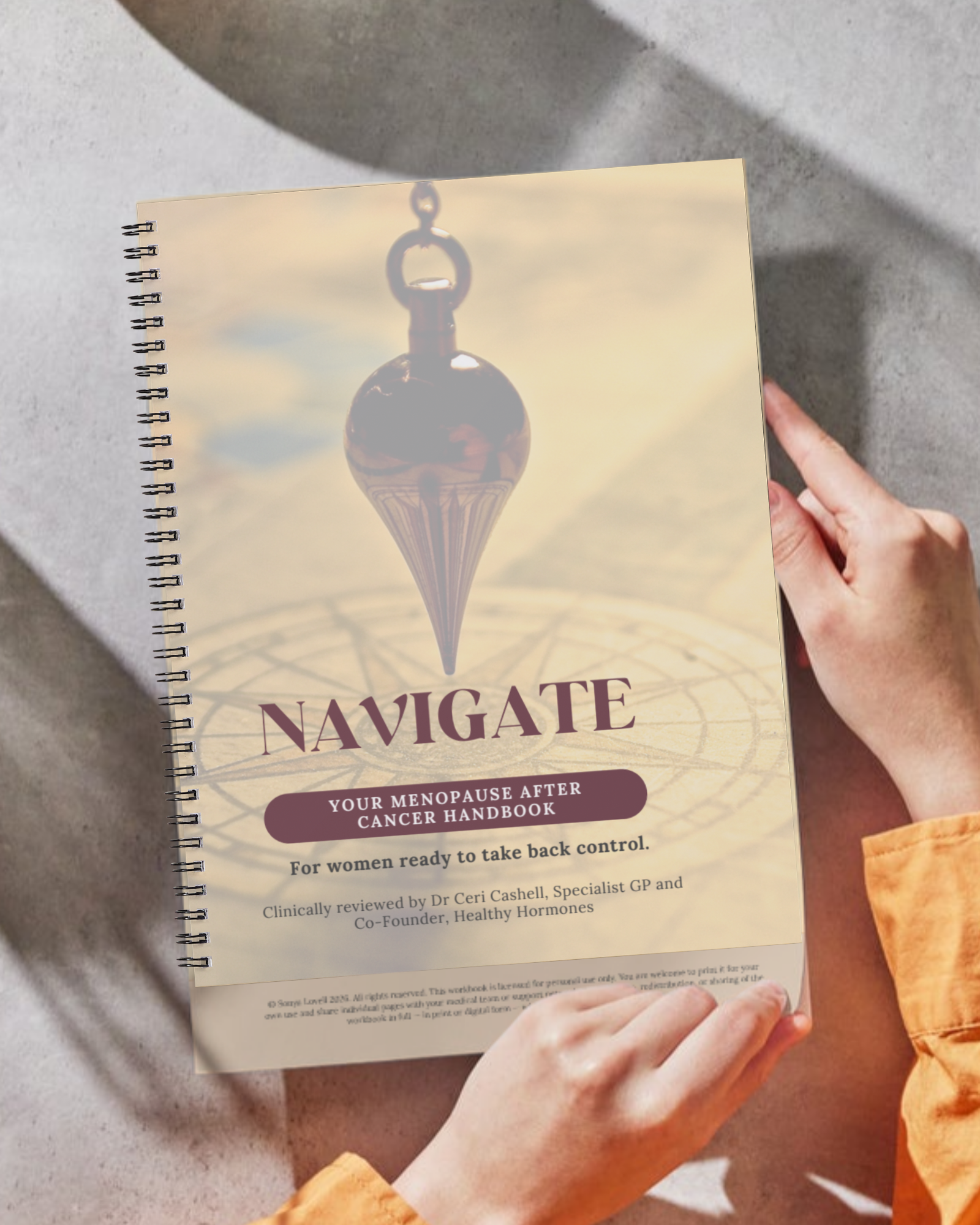
Navigate is a handbook built specifically for women navigating menopause after cancer, the one that should have been handed to you the moment active treatment ended
It won't tell you what to decide. It will give you the clarity to decide for yourself.
Inside, you'll map your diagnosis and treatment history, understand why your experience of menopause is different from women who haven't had cancer, identify the questions that matter for your situation, and walk into your next medical appointment knowing exactly what to ask and what a good response looks like.
It is not a substitute for medical care. It is the preparation that makes medical care actually work for you.
Your next doctor’s appointment is coming. You can walk in the way you always have, hoping the right questions come to you in the moment, leaving with less than you arrived with. Or you can walk in prepared, for twenty-seven dollars and an hour of your time, with the questions that belong in that room already on the page in front of you.
Section 1
Where You Are Right Now
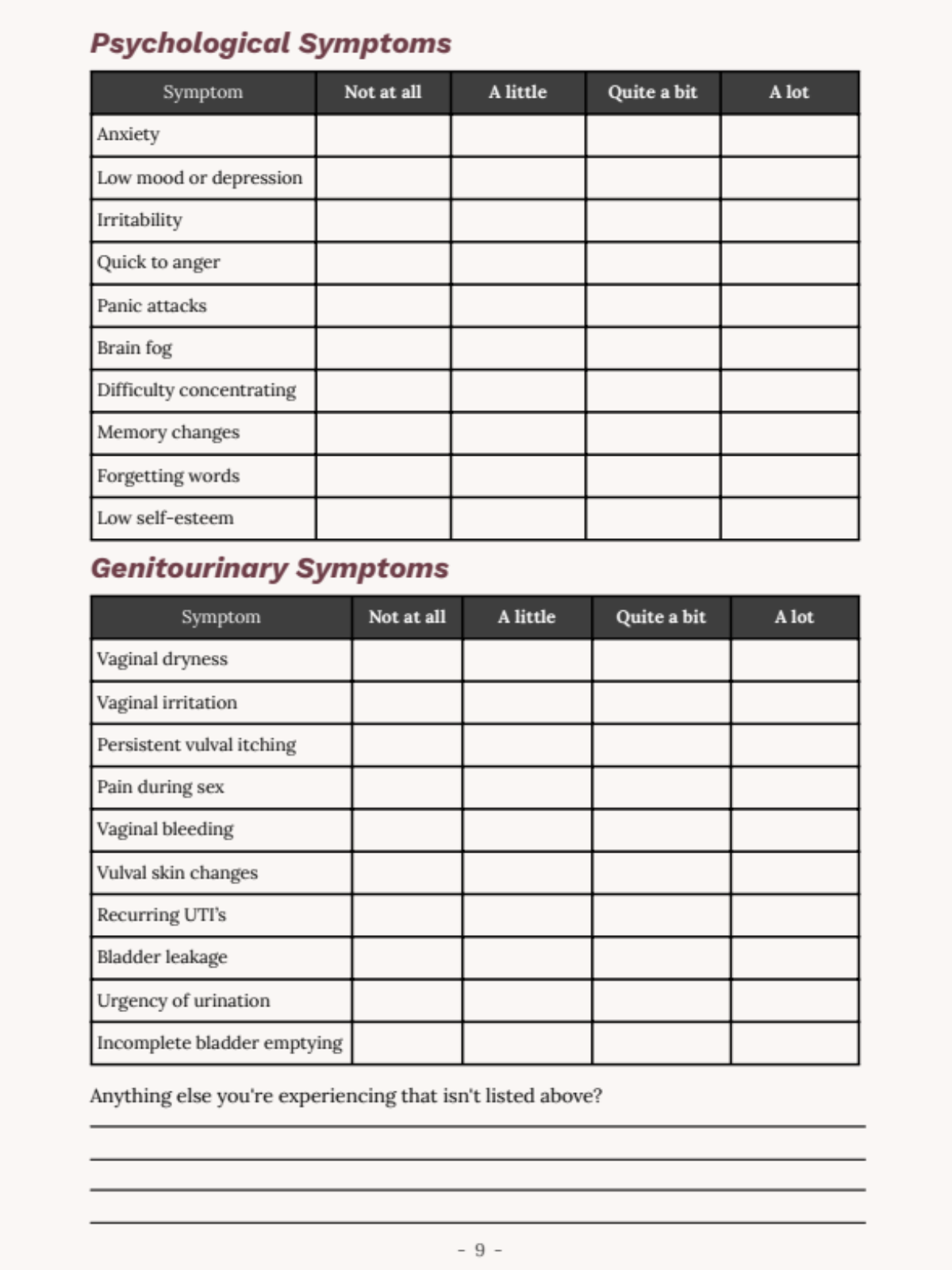
You'll map your diagnosis, treatment, timeline, and symptoms in one place, creating a clear picture of your situation that you can bring to every appointment. No more starting from scratch every time you see a new specialist.
What's inside Navigate
Section 2
Understanding Your Landscape
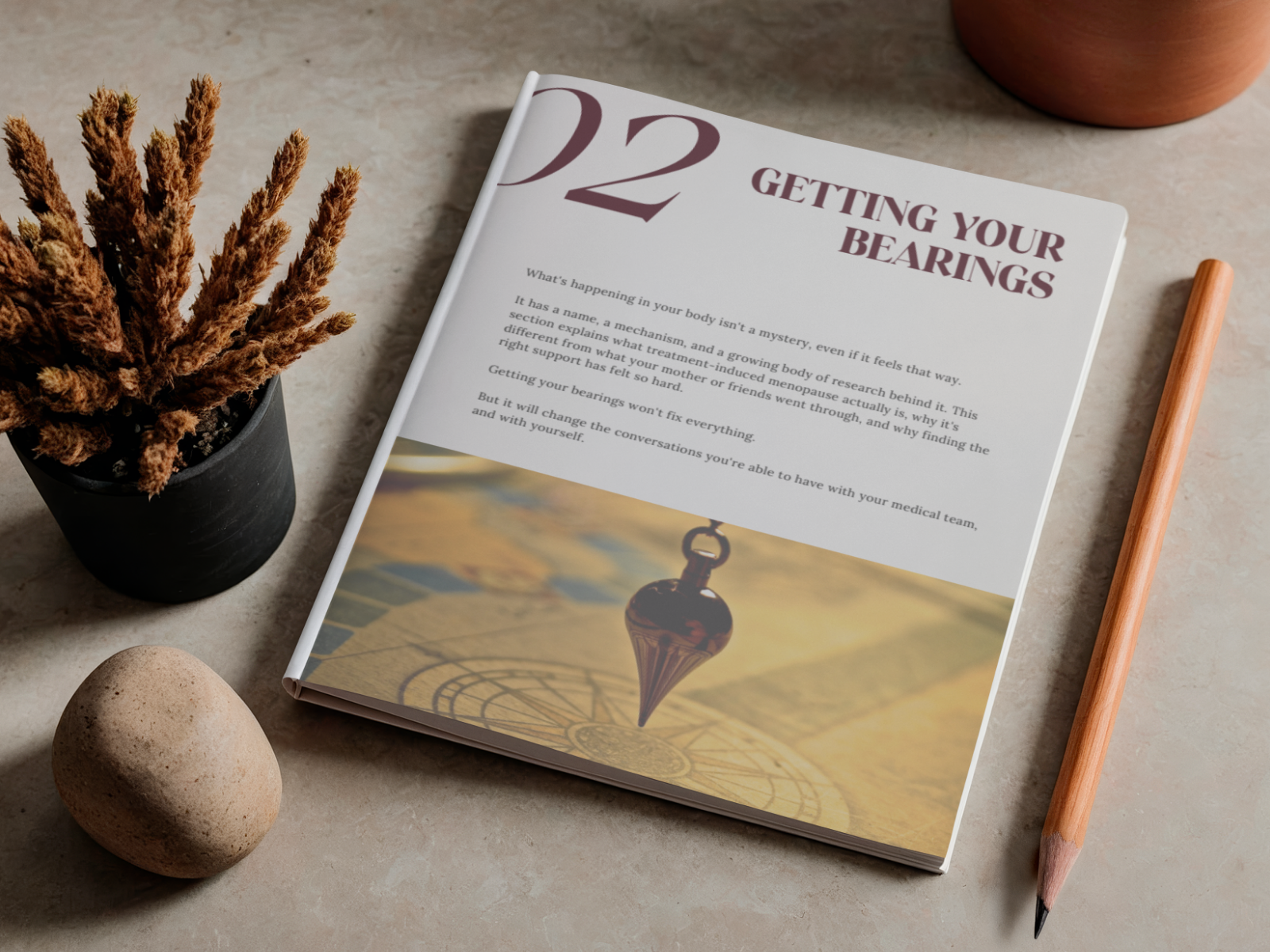
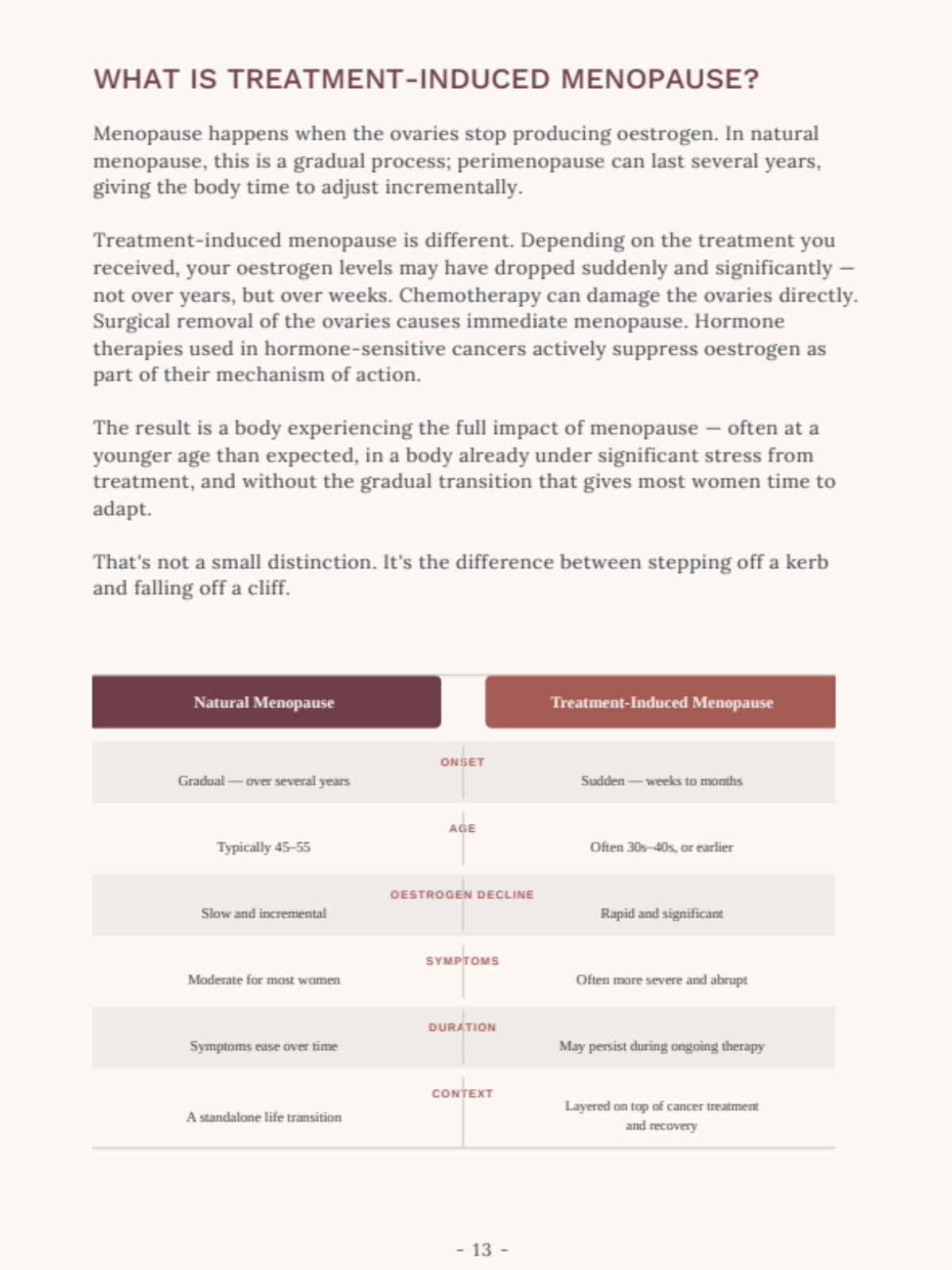
You'll understand why treatment-induced menopause is different, and why the advice designed for women who haven't had cancer often doesn't apply to you. For the first time, what's happening in your body will make sense.
Section 3
The Questions That Matter
You'll walk into your next appointment prepared. Questions organised by specialist type, oncologist, GP, gynaecologist, allied health, so you know exactly what to ask, who to ask it to, and what a good response looks like. And what a dismissive one looks like too.
Section 4
Your Next Steps
You'll finally have clarity on what to prioritise and what to do first. No overwhelming list of everything you should be doing. One clear next step for your specific situation.
Pages You’ll See Inside Navigate
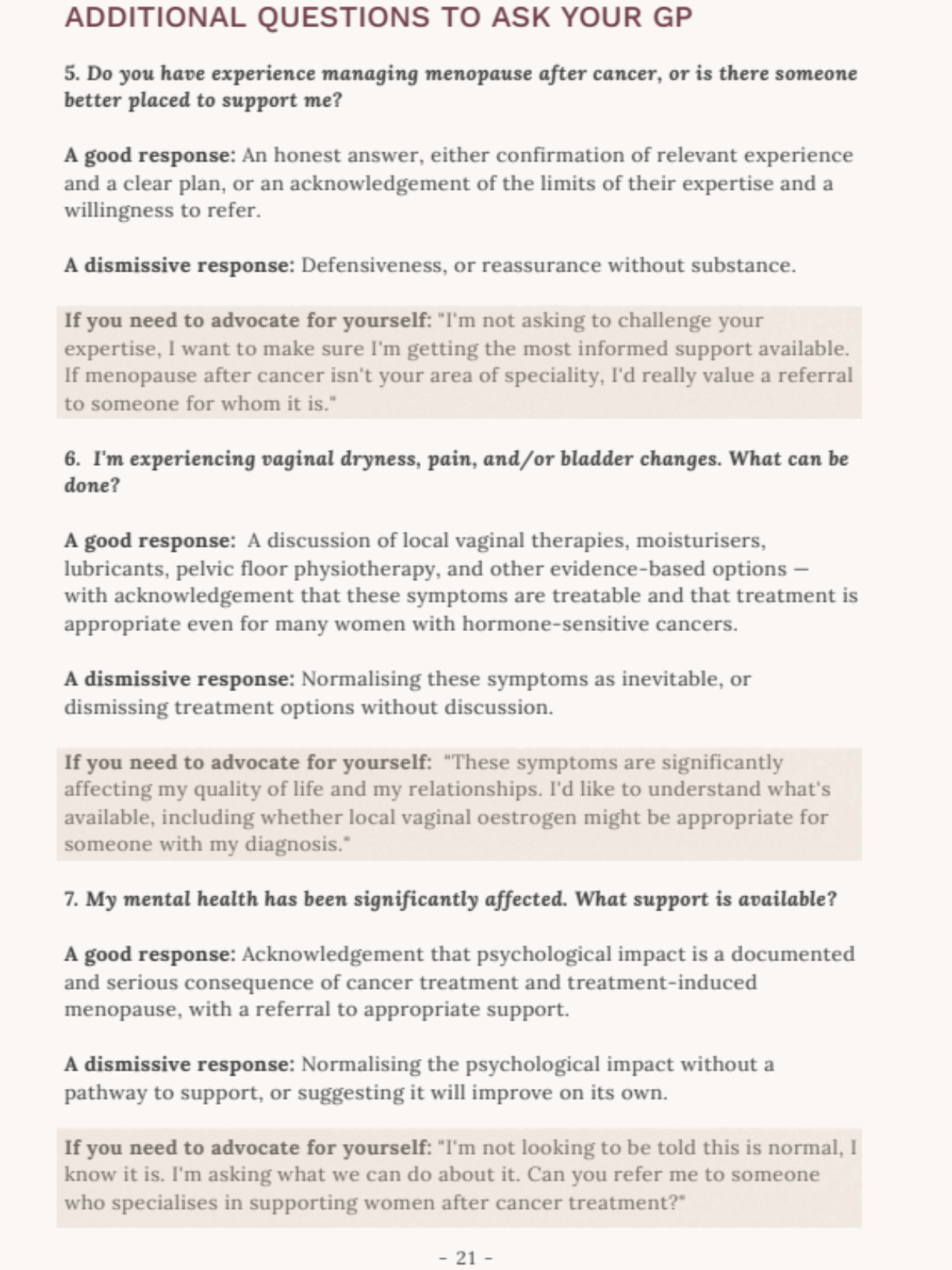
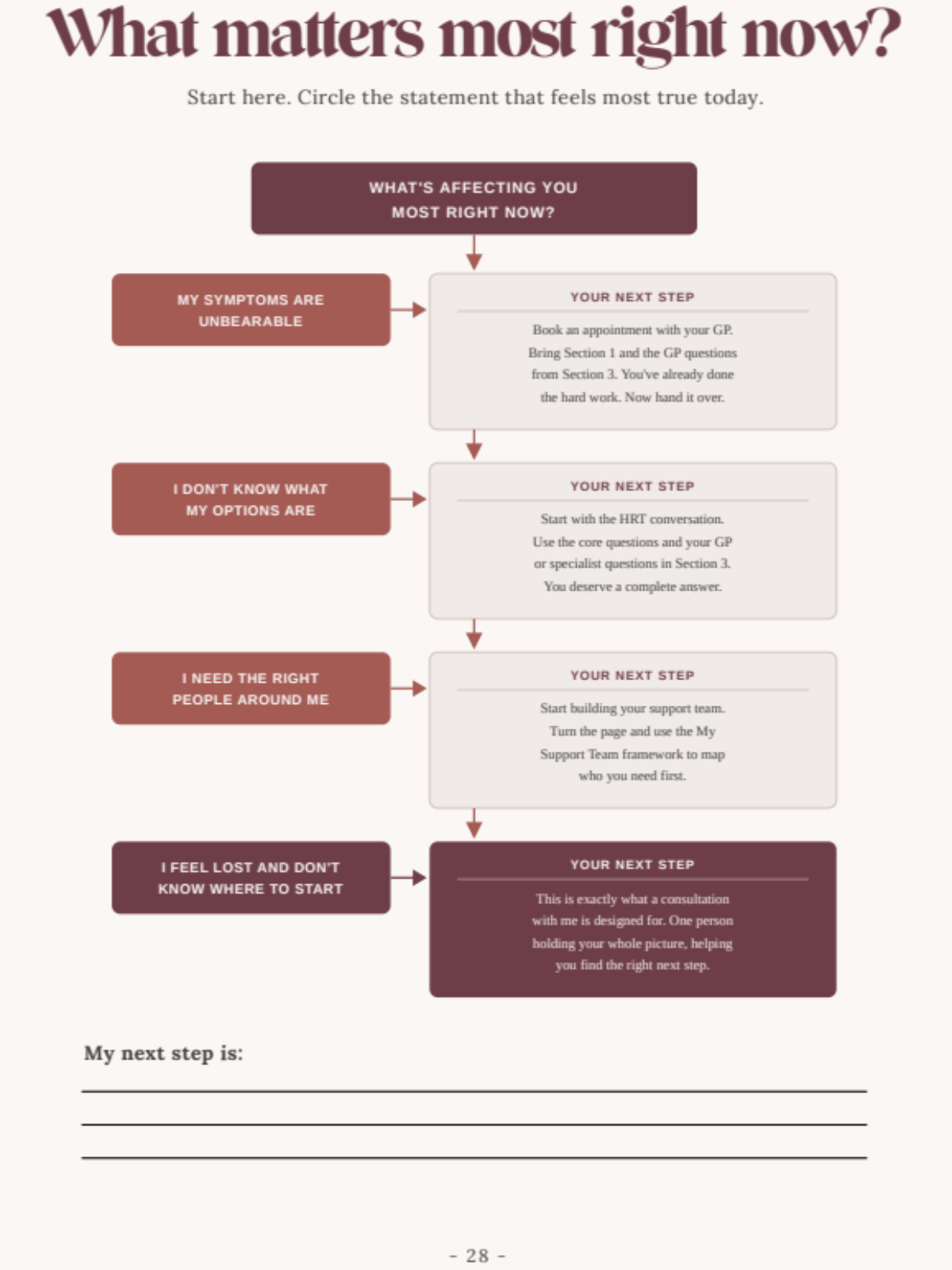
You're months or years post-treatment and still waiting to feel like yourself again.
You've been told your results are good, your treatment worked, you should be feeling better by now. But you're not. And you're starting to wonder if this is just your life now. It isn't. Navigate was built for exactly this moment.
Is Navigate right for you?
You're preparing for a medical appointment and don't know what to ask.
You have fifteen minutes with a specialist and a head full of questions you can't organise. Navigate gives you the right questions for your diagnosis profile, organised by specialist type, ready to take into the room with you.
You're done researching alone and need a framework, not more information.
You're not lacking effort or intelligence. You're lacking a structure that makes sense of everything you already know — and tells you what it means for you specifically. That's what Navigate does.
I know this because I lived it.
I'm Sonya Lovell, founder of Menopause After Cancer and host of the Dear Menopause podcast.
I was diagnosed with breast cancer at 47. Treatment ended, and I waited to feel better. Instead, I felt worse, with severe night sweats, joint pain, brain fog and word loss so bad a GP suggested it might be dementia, 20kg of weight gain, and a quality of life I didn't recognise as mine. I researched relentlessly, pushed back on closed doors, and advocated for myself until I was exhausted.
It took me six years to get the support I needed. Six years is too long. Navigate exists so it doesn't take that long for you.
I've spent fifteen years in women's health, hosted 127 episodes of Dear Menopause with more than 130,000 downloads, co-authored research published in the ANZ Journal of Psychiatry, and spoken at the Senate Inquiry into Perimenopause and Menopause in Canberra. I've interviewed the world's leading voices in oncology, menopause, and women's health, and I've brought everything I learned into this handbook.
My authority here isn't adjacent. It's embodied.

Everything you need to understand your situation, prepare for your appointments, and take your next step — in one handbook, built specifically for women navigating menopause after cancer.
You've waited long enough.
Navigate — Your Handbook for Menopause After Cancer
✓ Section 1 — Where You Are Right Now
✓ Section 2 — Understanding Your Landscape
✓ Section 3 — The Questions That Matter
✓ Section 4 — Your Next Steps
Printable. Shareable with your medical team and support network. Yours to keep.
$27 AUD
Questions you might have
1
Is this relevant if I had hormone-positive breast cancer?
Yes. Navigate is built for women across all cancer diagnoses and treatment profiles, including hormone-positive breast cancer. It won't tell you what to decide about HRT or any other treatment. What it will do is give you the right questions to have that conversation with a specialist who understands your specific diagnosis and risk profile. Every woman deserves that conversation, and Navigate helps you prepare for it.
Is this medical advice?
2
No. Navigate is an education and preparation tool. It will help you understand your situation, organise your experience, and prepare for medical appointments, but it does not replace clinical care, and it does not make recommendations about your treatment. The decisions belong to you and your medical team. Navigate helps you show up to those conversations prepared.
Navigate has been clinically reviewed by Dr Ceri Cashell, Specialist GP and Co-Founder of Healthy Hormones, one of Australia's leading voices in menopause medicine. Dr Cashell reviewed the clinical content to ensure it reflects current evidence and is safe and appropriate for women navigating menopause after cancer.
I'm still in active treatment. Is this for me?
3
Navigate is designed for after active treatment ends. If you're still in treatment, now isn't the right time, but it will be. Download my free guide “Questions You’re Allowed To Ask” and come back for Navigate when the time is right.
What format is Navigate in?
4
Navigate is a downloadable PDF handbook. Once your purchase is complete you'll receive immediate access. It's designed to be printed, single or double-sided, and brought to appointments. You can also share individual pages with your medical team or support network.
I've bought guides and workbooks before that were disappointing. How is this different?
5
Most guides give you generic information and leave you to figure out what applies to you. Navigate is built around your specific situation, your diagnosis, your treatment history, your symptoms, your next appointment. It's not an information dump. It's a framework that makes sense of your experience and tells you what to do next.
You don't have to figure this out alone.
You open Navigate. You map your diagnosis, your treatment history, your timeline, the symptoms nobody connected. The questions narrow to the ones that actually apply to your situation, your cancer, your treatment, your body right now.
You print the pages that matter, fold them into your bag, and walk into Thursday's oncology appointment with something in your hand for the first time.
Every section of Navigate has been clinically reviewed by Dr Ceri Cashell, Specialist GP and one of Australia's leading voices in menopause medicine, who verified that the content reflects current evidence and is safe and appropriate for all diagnoses, including hormone-positive breast cancer.
By purchasing this digital product, you acknowledge that all sales are final. Because you receive immediate access to downloadable files and online resources, no refunds or exchanges will be issued once your order is completed.